CBSE Class 10 Science 2023 Question Paper
This question paper contains 39 questions. All questions are compulsory. Question paper is divided into five sections -Section A, B, C, D and E.
In section A - question number 1 to 20 are multiple choice questions (MCQs) carrying 1 mark each. In section B - question number 21 to 26 are very short answer (VSA) type questions carrying 2 marks each. Answer to these questions should be in the range of 30 to 50 words.
In section C - question number 27 to 33 are short answer (SA) type questions carrying 3 marks each. Answer to these questions should in the range of 50 to 80 words. In section D - question number 34 to 36 are long answer (LA) type questions carrying 5 marks each. Answer to these questions should be in the range of 80 to 120 words. In section E - question number 37 to 39 are of 3 source based/case based units of assessment carrying 4 marks each with sub-parts.
Section - A
(Multiple Choice Questions)
1. When Sodium bicarbonate reacts with dilute hydrochloric acid, the gas evolved is :
- Hydrogen; it gives pop sound with burning match stick.
- Hydrogen; it turns lime water milky.
- Carbon dioxide; it turns lime water milky.
- Carbon dioxide; it blows off a burning match stick with a pop sound.
2. When aqueous solutions of potassium iodide and lead nitrate are mixed, an insoluble substance separates out. The chemical equation for the reaction involved is :
- KI + PbNO3 → PbI + KNO3
- 2KI + Pb(NO3)2 → PbI2 + 2KNO3
- KI + Pb(NO3)2 → PbI + KNO3
- KI + PbNO3 → PbI2 + KNO3
3. A metal ribbon X burns in oxygen with a dazzling white flame forming a white ash Y. The correct description of X, Y and the type of reaction is :
- X = Ca ; Y = CaO ; Type of reaction = Decomposition
- X = Mg ; Y = MgO ; Type of reaction = Combination
- X = Al ; Y = Al2O3 ; Type of reaction = Thermal decomposition
- X = Zn ; Y = ZnO ; Type of reaction = Endothermic
4. Acid present in tomato is :
- Methanoic acid
- Acetic acid
- Lactic acid
- Oxalic acid
5. Sodium hydroxide is termed an alkali while Ferric hydroxide is not because :
- Sodium hydroxide is a strong base, while Ferric hydroxide is a weak base.
- Sodium hydroxide is a base which is soluble in water while Ferric hydroxide is also a base but it is not soluble in water.
- Sodium hydroxide is a strong base while Ferric hydroxide is a strong acid.
- Sodium hydroxide and Ferric hydroxide both are strong base but the solubility of Sodium hydroxide in water is comparatively higher than that of Ferric hydroxide.
6. The name of the salt used to remove permanent hardness of water is :
- Sodium hydrogen carbonate (NaHCO3)
- Sodium chloride (NaCl)
- Sodium carbonate decahydrate (Na2CO3.10H2O)
- Calcium sulphate hemihydrate (CaSO4.½H2O)
7. The electron dot structure of chlorine molecule is :

8. Observe the following diagram and identify the process and its significance from the following options :
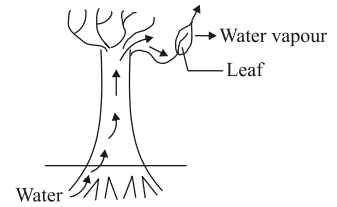
- Evaporation : maintains water contents in leaf cells.
- Transpiration : creates a suction force which pulls water inside the plant.
- Excretion : helps in excreting out waste water from the plant.
- Translocation : helps in transporting materials from one cell to another.
9. Opening and closing of stomata is due to :
- High pressure of gases inside the cells.
- Movement of water in and out of the guard cells.
- Stimulus of light in the guard cells.
- Diffusion of CO2 in and out of the guard cells.
10. A cross between pea plant with white flowers (vv) and pea plant with violet flowers (VV) resulted in F2 progeny in which ratio of violet (VV) and white (vv) flowers will be :
- 1 : 1
- 2 : 1
- 3 : 1
- 1 : 3
11. In plants the role of cytokinin is :
- Promote cell division.
- Wilting of leaves.
- Promote the opening of stomatal pore.
- Help in the growth of stem.
12. The number of chromosomes in parents and offsprings of a particular species undergoing sexual reproduction remain constant due to :
- doubling of chromosomes after zygote formation.
- halving of chromosomes after zygote formation.
- doubling of chromosomes before gamete formation.
- halving of chromosomes at the time of gamete formation.
13. Two LED bulbs of 12W and 6W are connected in series. If the current through 12W bulb is 0.06A the current through 6W bulb will be :
- 0.04A
- 0.06A
- 0.08A
- 0.12A
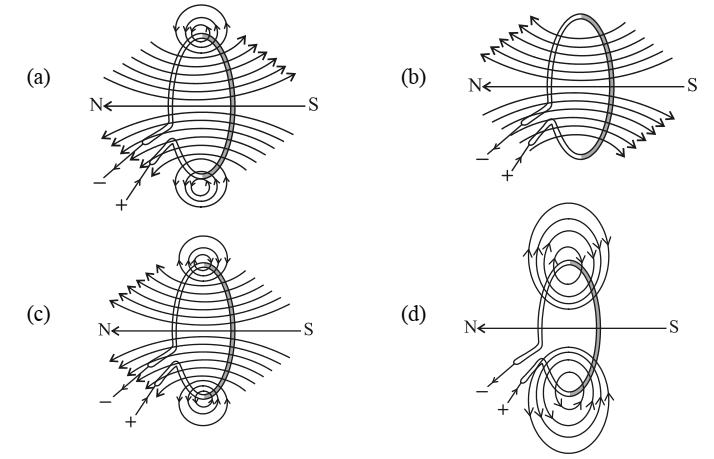
14. The correct pattern of magnetic field lines of the field produced by a current carrying circular loop is :
15. The resistance of a resistor is reduced to half of its initial value. If other parameters of the electrical circuit remain unaltered, the amount of heat produced in the resistor will become :
- four times
- two times
- half
- one fourth
16. An alpha particle enters a uniform magnetic field as shown. The direction of force experienced by the alpha particle is :
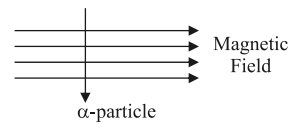
- towards right
- towards left
- into the page
- out of the page
Q. No. 17 to 20 are Assertion - Reasoning based questions.
These consist of two statements - Assertion (A) and Reason (R). Answer these questions selecting the appropriate option given below.
- Both (A) and (R) are true and (R) is the correct explanation of (A).
- Both (A) and (R) are true but (R) is not the correct explanation of (A).
- (A) is true but (R) is false.
- (A) is false but (R) is true.
17. Assertion (A) : Reaction of Quicklime with water is an exothermic reaction.
Reason (R) : Quicklime reacts vigorously with water releasing a large amount of heat.
18. Assertion (A) : In humans, if gene (B) is responsible for black eyes and gene (b) is responsible for brown eyes, then the colour of eyes of the progeny having gene combination Bb, bb or BB will be black only.
Reason (R) : The black colour of the eyes is a dominant trait.
19. Assertion (A) : The inner walls of the small intestine have finger like projections called villi which are rich in blood.
Reason (R) : These villi have a large surface area to help the small intestine in completing the digestion of food.
20. Assertion (A) : A current carrying straight conductor experiences a force when placed perpendicular to the direction of magnetic field.
Reason (R) : The net charge on a current carrying conductor is always zero.
Section - B
(Very Short Answer Questions)
21. (A) A student took a small amount of copper oxide in a conical flask and added dilute hydrochloric acid to it with constant stirring. He observed a change in colour of the solution.
- Write the name of the compound formed and its colour.
- Write a balanced chemical equation for the reaction involved.
OR
(B) The industrial process used for the manufacture of caustic soda involves electrolysis of an aqueous solution of compound ‘X’. In this process, two gases ‘Y’ and ‘Z’ are liberated. ‘Y’ is liberated at cathode and ‘Z’, which is liberated at anode, on treatment with dry slaked lime forms a compound ‘B’. Name X, Y, Z and B.
22. (A) Name the part of brain which is responsible for the following actions :
- Maintaining posture and balance
- Beating of heart
- Thinking
- Blood pressure
OR
(B) Where are auxins synthesized in a plant ? Which organ of the plant shows :
- Positive phototropism
- Negative geotropism
- Positive hydrotropism
23. Write one specific function each of the following organs in relation with excretion in human beings :
- Renal Artery
- Urethra
- Glomerulus
- Tubular part of nephron
24. Two green plants are kept separately in oxygen free containers, one in the dark and other in sunlight. It was observed that plant kept in dark could not survive longer. Give reason for this observation.
25. (A) Observe the following diagram and answer the questions following it :
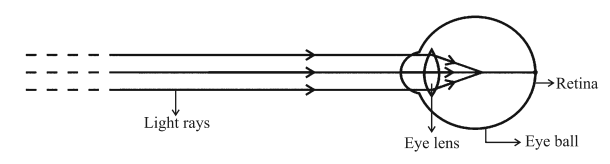
- Identify the defect of vision shown.
- List its two causes.
- Name the type of lens used for the correction of this defect.
OR
(B) The colour of clear sky from the earth appears blue but from the space it appears black. Why ?
26. Use of several pesticides which results in excessive accumulation of pesticides in rivers or ponds, is a matter of deep concern. Justify this statement.
Section - C
(Short Answer Questions)
27. (i) While electrolysing water before passing the current some drops ofan acid are added. Why ? Name the gases liberated at cathode and anode. Write the relationship between the volume of gas collected at anode and the volume of gas collected at cathode.
(ii) What is observed when silver chloride is exposed to sunlight ? Give the type of reaction involved.
28. (i) Suggest a safe procedure of diluting a strong concentrated acid.
(ii) Name the salt formed when sulphuric acid is added to sodium hydroxide and write its pH.
(iii) Dry HCl gas does not change the colour of dry blue litmus paper. Why ?
29. (A) (i) How does Paramecium obtain its food ?
(ii) List the role of each of the following in our digestive system :
- Hydrochloric acid
- Trypsin
- Muscular walls of stomach
- Salivary amylase
OR
(B) (i) What is double circulation ?
(ii) Why is the separation of the right side and the left side of the heart useful ? How does it help birds and mammals ?
30. (A) Define the following terms in the context of a diverging mirror :
- Principal focus
- Focal length
Draw a labelled ray diagram to illustrate your answer.
OR
(B) An object of height 10 cm is placed 25 cm away from the optical centre of a converging lens of focal length 15 cm. Calculate the image-distance and height of the image formed.
31. The power of a lens is +4D. Find the focal length of this lens. An object is placed at a distance of 50 cm from the optical centre of this lens. State the nature and magnification of the image formed by the lens and also draw a ray diagram to justify your answer.
32. (A) (i) Why is an alternating current (A.C.) considered to be advantageous over direct current (D.C.) for the long distance transmission of electric power ?
(ii) How is the type of current used in household supply different from the one given by a battery of dry cells ?
(iii) How does an electric fuse prevent the electric circuit and the appliances from a possible damage due to short circuiting or overloading.
OR
(B) For the current carrying solenoid as shown, draw magnetic field lines and give reason to explain that out of the three points A, B and C, at which point the field strength is maximum and at which point it is minimum ?

33. Write one difference between biodegradable and non-biodegradable wastes. List two impacts of each type of the accumulated waste on environment if not disposed off properly.
Section - D
(Long Answer Questions)
34. (A) (i) Draw the structure of the following compounds :
- Butanoic acid
- Chloropentane
(ii) How are structure (i) and structure (ii) given below related to one another ? Give reason to justify your answer.
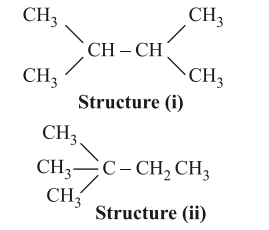
Draw one more possible structure for above case.
(iii) Differentiate between saturated and unsaturated carbon compounds on the basis of their general formula.
OR
(B) (i) What happens when a small piece of sodium is dropped in ethanol ? Write the equation for this reaction.
(ii) Why is glacial acetic acid called so ?
(iii) What happens when ethanol is heated at 443 K in the presence of conc. H2SO4 ? Write the role of conc. H2SO4 in this case.
(iv) Write an equation showing saponification.
35. (i) Name and explain the two modes of asexual reproduction observed in hydra.
(ii) What is vegetative propagation ? List two advantages of using this technique.
36. (i) How is electric current related to the potential difference across the terminals of a conductor ?
Draw a labelled circuit diagram to verify this relationship.
(ii) Why should an ammeter have low resistance ?
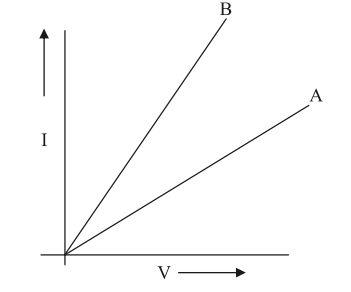
(iii) Two V - I graphs A and B for series and parallel combinations of two resistors are as shown. Giving reason state which graph shows (a) series, (b) parallel combination of the resistors.
Section - E
(Source Based/Case Based Questions)
37. The melting points and boiling points of some ionic compounds are given below :
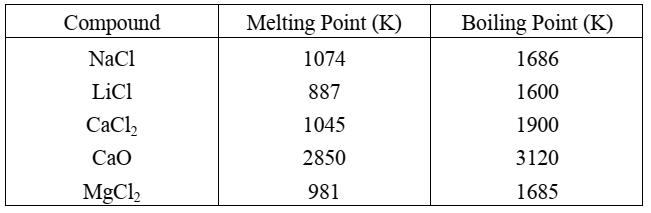
These compounds are termed ionic because they are formed by the transfer of electrons from a metal to a non-metal. The electron transfer in such compounds is controlled by the electronic configuration of the elements involved. Every element tends to attain a completely filled valence shell of its nearest noble gas or a stable octet.
(i) Show the electron transfer in the formation of magnesium chloride.
(ii) List two properties of ionic compounds other than their high melting and boiling points.
(iii) (A) While forming an ionic compound say sodium chloride how does sodium atom attain its stable configuration ?
OR
(iii) (B) Give reasons :
- Why do ionic compounds in the solid state not conduct electricity ?
- What happens at the cathode when electricity is passed through an aqueous solution of sodium chloride ?
38. The most obvious outcome of the reproductive process is the generation of individuals of similar design, but in sexual reproduction they may not be exactly alike. The resemblances as well as differences are marked. The rules of heredity determine the process by which traits and characteristics are reliably inherited. Many experiments have been done to study the rules of inheritance.
(i) Why an offspring of human being is not a true copy of his parents in sexual reproduction ?
(ii) While performing experiments on inheritance in plants, what is the difference between F1 and F2 generation ?
(iii) (A) Why do we say that variations are useful for the survival of a species over time ?
OR
(iii) (B) Study Mendel’s cross between two plants with a pair of contrasting characters.

He observed 4 types of combinations in F2 generation. Which of these were new combinations ? Why do new features which are not present in the parents, appear in F2 generation ?
39. The ability of a medium to refract light is expressed in terms of its optical density. Optical density has a definite connotation. It is not the same as mass density. On comparing two media, the one with the large refractive index is optically denser medium than the other. The other medium with a lower refractive index is optically rarer. Also the speed of light through a given medium is inversely proportional to its optical density.
(i) Determine the speed of light in diamond if the refractive index of diamond with respect to vacuum is 2.42. Speed of light in vacuum is 3 × 10⁸ m/s.
(ii) Refractive indices of glass, water and carbon disulphide are 1.5, 1.33 and 1.62 respectively. If a ray of light is incident in these media at the same angle (say θ), then write the increasing order of the angle of refraction in these media.
(iii) (A) The speed of light in glass is 2 × 10⁸ m/s and in water is 2.25 × 10⁸ m/s.
(a) Which one of the two is optically denser and why ?
(b) A ray of light is incident normally at the water-glass interface when it enters a thick glass container filled with water. What will happen to the path of the ray after entering the glass ? Give reason.
OR
(iii) (B) The absolute refractive indices of water and glass are 4/3 and 3/2 respectively. If the speed of light in glass is 2 × 10⁸ m/s, find the speed of light in (i) vacuum and (ii) water.