CBSE Class 10 Social Science 2021 Question Paper
1. Which one of the following was not included in the ‘Napoleonic Code’ of 1804 ?
(A) Privilege based on birth
(B) Abolished the feudal system
(C) Right to property
(D) Equality before law
2. Define the term ‘Liberalism’.
3. (a) Which of the following is not a part of the ‘United Kingdom of Great Britain’ ?
(A) England
(B) Poland
(C) Scotland
(D) Ireland
OR
(b) Who among the following was proclaimed as the ‘German Emperor’ in 1871 ?
(A) William I
(B) Otto von Bismarck
(C) Kaiser William
(D) Count Cavour
4. Which of the following is not a characteristic of ‘Intensive Subsistence Farming’ ?
(A) This is practised in areas of high population.
(B) It is an example of labour-intensive farming.
(C) High doses of biochemical inputs are used.
(D) It is an example of commercial farming.
5. (a) Name any one ‘rabi’ crop.
OR
(b) In which ‘cropping season’ are Jowar and Bajra crops grown in India ?
6. Which one of the following factors does not affect industrial location ?
(A) Raw material
(B) Labour
(C) Capital
(D) Rainfall
7. Match the following and select the correct option :
Sea Port - State
i. Kandla 1. West Bengal
il. Tuticorin 2. Odisha
ii. Paradwip 3. Tamil Nadu
iv. Haldia 4. Gujarat
Options:
(A) (i) - 1; (ii) - 2, (iii) - 3, (iv) - 4
(B) (i) - 2; (ii) - 3, (iii) - 1, (iv) - 4
(C) (i) - 4; (ii) - 3, (iii) - 2, (iv) - 1
(D) (i) - 4; (ii) - 3, (iii) - 1, (iv) - 2
8. Which of the following is a source of ‘mass communication’ ?
(A) Book
(B) Telephone
(C) Personal letter
(D) Parcel
9. Fill in the blank : 59 percent of the total population of Belgium lives in the ______ region.
10. (a) Which of the following is a subject of the Union List ?
(A) Defence
(B) Agriculture
(C) Trade
(D) Education
OR
(b) Which of the following is a subject of the State List ?
(A) Currency
(B) Foreign Affairs
(C) Banking
(D) Commerce
11. Which one of the following types of government promotes equality among citizens ?
(A) Democracy
(B) Dictatorship
(C) Autocracy
(D) Aristocracy
12. Study the table and answer the question given below :

In Uttar Pradesh what percentage of female children (girls) aged 10 - 14 years are not attending school ?
13. Which one of the following activities comes under ‘Primary sector’ ?
(A) Mining
(B) Transport
(C) Education
(D) Storage
14. (a) The exchange of goods with a commodity is known as:
(A) Double coincidence of wants
(B) Local trade
(C) Domestic trade
(D) Foreign trade
OR
(b) Which one of the following mediums of exchange is convenient ?
(A) Money
(B) Commodity
(C) Gold
(D) Silver
15. Which of the following authorities of India issues currency notes on behalf of the Central Government ?
(A) The State Bank of India
(B) The Reserve Bank of India
(C) The Allahabad Bank
(D) The Punjab National Bank
16. Which one of the following is a formal source of loan ?
(A) Relatives
(B) Landlord
(C) Bank
(D) Friend
Section B (6 x 3 = 18)
17. (a) Describe the spirit of conservatism in European governments brought after the defeat of Napoleon in 1815.
OR
(b) Describe the major outcomes of the French Revolution of 1789.
18. How did the ‘Greek War of Independence’ contribute in mobilizing nationalist feeling among the educated elite across Europe ? Explain with examples.
19. Why are manufacturing industries considered as the backbone of economic development of a country ? Explain.
20. How did the Belgium government accommodate the social differences ? Explain with examples.
21. (a) "Money in your pocket cannot buy all the goods and services that you may need to live well." Support the statement with example.
OR
(b) "Different persons can have different developmental goals." Support the statement with example.
22. How do the workers of organised sector receive the benefit of employment security ? Explain with examples.
Section C (4 x 4 = 16)
23. Read the source given below and answer the questions that follow :
In February 1922, Mahatma Gandhi decided to withdraw the Non-Cooperation Movement. He felt the movement was turning violent in many places and satyagrahis needed to be properly trained before they would be ready for mass struggles. Within the Congress, some leaders were by now tired of mass struggles and wanted to participate in elections to the provincial councils that had been set up by the Government of India Act of 1919. They felt that it was important to oppose British policies within the councils, argue for reform and also demonstrate that these councils were not truly democratic. C.R. Das and Motilal Nehru formed the Swaraj Party within the Congress to argue for a return to council politics. But younger leaders like Jawaharlal Nehru and Subhas Chandra Bose pressed for more radical mass agitation and for full independence.
In such a situation of internal debate and dissension two factors again shaped Indian politics towards the late 1920s. The first was the effect of the worldwide economic depression. Agricultural prices began to fall from 1926 and collapsed after 1930. As the demand for agricultural goods fell and exports declined, peasants found it difficult to sell their harvests and pay their revenue. By 1930, the countryside was in turmoil.
Answer the following MCQs by choosing the most appropriate option :
(23.1) When did the Non-Cooperation - Khilafat Movement begin ?
(A) 1920
(B) 1921
(C) 1922
(D) 1918
(23.2) Why was the countryside in turmoil by 1930 ?
(A) Increased production in agriculture
(B) Distress in countryside
(C) Decreased production in agriculture
(D) Worldwide economic depression
(23.3) Why did Mahatma Gandhi decide to withdraw the Non-Cooperation Movement in February 1922 ?
(A) Due to Rowlatt Act
(B) Due to Simon Commission
(C) Due to Jallianwala Bagh Incident
(D) Due to Chauri-Chaura Incident
(23.4) Which leaders of the Congress Party wanted to participate in elections to the provincial councils ?
(A) Jawaharlal Nehru and Subhas Chandra Bose
(B) C.R. Das and Motilal Nehru
(C) Bal Gangadhar Tilak and Bipin Chandra Pal
(D) Thakurdas and G.D. Birla
24. Read the source given below and answer the questions that follow :
Mining sites are abandoned after excavation work is complete leaving deep scars and traces of over-burdening. In states like Jharkhand, Chhattisgarh, Madhya Pradesh and Odisha, deforestation due to mining have caused severe land degradation. In states like Gujarat, Rajasthan, Madhya Pradesh and Maharashtra, overgrazing is one of the main reasons for land degradation. In the states of Punjab, Haryana, Western Uttar Pradesh, over-irrigation is responsible for land degradation due to water logging leading to increase in salinity and alkalinity in the soil. The mineral processing like grinding of limestone for cement industry and calcite and soapstone for ceramic industry generates huge quantity of dust in the atmosphere. It retards the process of infiltration of water into the soil after it settles down on the land. In recent years, industrial effluents as waste have become a major source of land and water pollution in many parts of the country.
Answer the following MCQs by choosing the most appropriate option :
(24.1) In which one of the following states is overgrazing the main reason for ‘land degradation’ ?
(A) Gujarat
(B) Himachal Pradesh
(C) Punjab
(D) Madhya Pradesh
(24.2) Which one of the following is a major source of water pollution ?
(A) Rainfall
(B) Landslide
(C) Over-irrigation
(D) Industrial waste
(24.3) Why is ‘over-irrigation’ responsible for land degradation ?
(A) Increases the salinity of soil
(B) Decreases the water absorption capacity of soil
(C) Increases landslides
(D) Decreases the fertility of soil
(24.4) Which one of the following is the main reason of ‘land degradation’ in Jharkhand ?
(A) Overgrazing
(B) Over-irrigation
(C) Industrial waste
(D) Mining
25. Read the source given below and answer the questions that follow :
Democracies that follow a federal system all over the world tend to have two kinds of political parties : parties that are present in only one of the federal units and parties that are present in several or all units of the federation. This is the case in
India as well. There are some countrywide parties, which are called ‘national parties’. These parties have their units in various states. But by and large all these units follow the same policies, programmes and strategy that is decided at the national level.
Every party in the country has to register with the Election Commission. While the Commission treats all parties equally, it offers some special facilities to large and established parties. These parties are given a unique symbol - only the official candidates of that party can use that election symbol. Parties that get this privilege and some other special facilities are ‘recognised’ by the Election Commission for this purpose. That is why these parties are called, ‘recognised political parties’. The Election Commission has laid down detailed criteria of the proportion of votes and seats that a party must get in order to be a recognised party. A party that secures at least 6 percent of the total votes in an election to the Legislative Assembly of a State and wins at least two seats is recognised as a State party. A party that secures at least six percent of total votes in Lok Sabha elections or Assembly elections in four States and wins at least four seats in the Lok Sabha is recognised as a National party.
Answer the following MCQs by choosing the most appropriate option :
(25.1) Which one of the following is a National party ?
(A) Bharatiya Janata Party
(B) Samajwadi Party
(C) Shiv Sena
(D) Shiromani Akali Dal
(25.2) Which of the following is not a regional party ?
(A) Jharkhand Mukti Morcha
(B) Asom Gana Parishad
(C) Indian National Congress
(D) Dravida Munnetra Kazhagam
(25.3) Where does every political party have to register in India ?
(A) Government of India
(B) NITI Aayog
(C) Election Commission
(D) Law Commisssion
(25.4) When a party that secures at least six percent of total votes in Lok Sabha elections or Assembly elections in four states and wins at least four seats of Lok Sabha, it is recognised as a:
(A) Regional Party
(B) National Party
(C) Pressure Group
(D) Business Organisation
26. Read the source given below and answer the questions that follow :
We have seen that the liberalisation of foreign trade and investment in India was supported by some very powerful international organisations. These organisations say that all barriers to foreign trade and investment are harmful. There should be no barriers. Trade between countries should be ‘free’. All countries in the world should liberalise their policies.
World Trade Organisation (WTO) is one such organisation whose aim is to liberalise international trade. Started at the initiative of the developed countries, WTO establishes rules regarding international trade, and sees that these rules
are obeyed. 149 countries of the world are currently members of the WTO (2006).
Though WTO is supposed to allow free trade for all, in practice, it is seen that the developed countries have unfairly retained trade barriers. On the other hand, WTO rules have forced the developing countries to remove trade barriers. An example of this is the current debate on trade in agricultural products.
Answer the following MCQs by choosing the most appropriate option :
(26.1) Which among the following organisations establishes the rules regarding international trade ?
(A) WHO
(B) WTO
(C) UPU
(D) IMF
(26.2) Which of the following is the aim of World Trade Organisation ?
(A) To liberalise international trade
(B) To provide loans to the developing countries
(C) To help countries economically
(D) To resolve the political disputes between countries
(26.3) Which one of the following options defines ‘Liberalisation’ ?
(A) Impose the tax on economic activities
(B) To set barriers by the government in the economic field
(C) To remove barriers set by the government
(D) Self-control on all economic activities
(26.4) Who among the following had initiated to start the World Trade Organization (WTO) ?
(A) European Union
(B) Non-Aligned countries
(C) Developing countries
(D) Developed countries
Section D (5 x 5 = 25)
27. (a) Describe the economic impact of the First World War on India.
OR
(b) Describe any two Satyagraha movements launched by Gandhiji just after his return to India from South Africa.
28. "Under globalisation particularly after 1990, the farmers in India have been exposed to new challenges." Support the statement.
29. "Federalism is a system of government in which the power is divided between a central authority and various constituent units of the country." Support the statement in reference to India.
30. (a) How does democracy produce a harmonious social life ? Explain.
OR
(b) How does democracy protect the dignity and freedom of citizens ? Explain.
31. (a) "The use of money spans a very large part of our everyday life." Support the statement.
OR
(b) "Credit pushes the borrower into situations from which recovery is very painful." Support the statement.
Section E
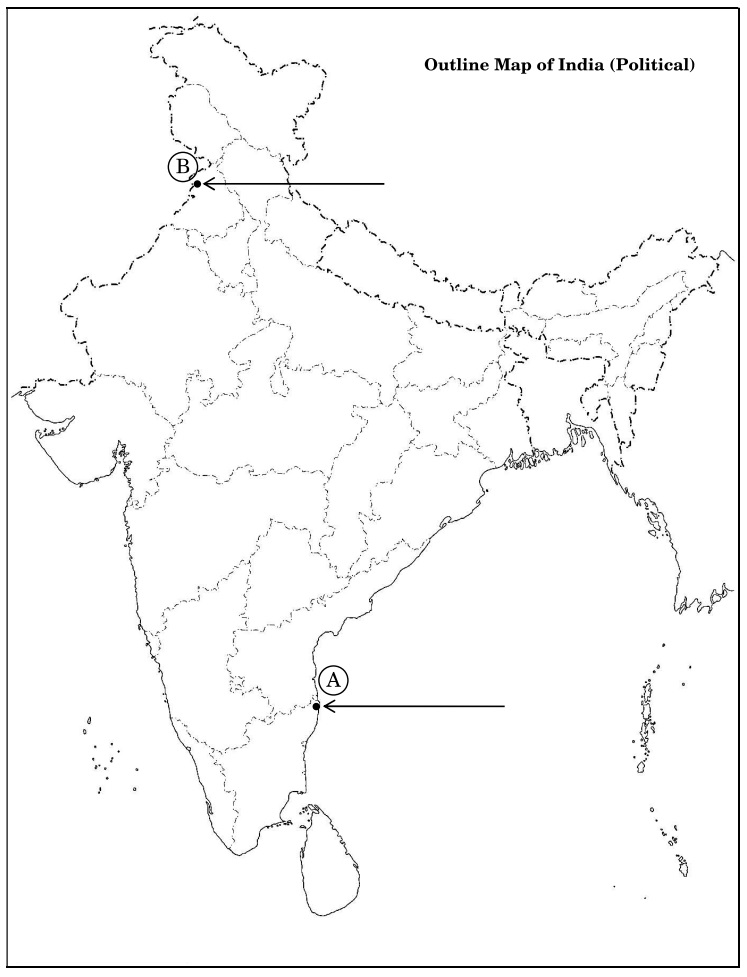
(Map Skill-based question)
32. (a) Two places A and B are marked on the given political outline map of India. Identify these features with the help of the following information and write their correct names on the lines drawn near them : 2 x 1 = 2
- The place where the Indian National Congress Session was held.
- The place where the Jallianwala Bagh incident occurred.
(b) Locate and label any three of the following with appropriate symbols on the same given political outline map of India : 3 x 1 = 3
- Tarapur - Nuclear Power Plant
- Indore - Cotton Textile Industry
- Salem - Iron and Steel Plant
- Noida - Software Technology Park
- Kolkata - International Airport