CBSE Class 10 Science 2021 Question Paper
1. (a) What is a balanced chemical equation ?
OR
(b) Why is respiration considered an exothermic reaction ?
2. Name the type of chemical reaction which takes place when quicklime is added to water.
3. State the purpose for which litmus is used in laboratories.
4. (a) Why is potassium kept immersed in kerosene ?
OR
(b) Write the name of an allotrope of carbon.
5. Write the structural formula of an organic compound in which a heteroatom is present.
6. (a) Why do arteries have thick elastic walls ?
OR
(b) Name the molecule of energy which is synthesized during respiration.
7. Define fragmentation.
8. Which one of the following is the correct reason for twinkling of stars ?
(A) Atmospheric reflection of starlight
(B) Atmospheric refraction of starlight
(C) Scattering of starlight
(D) Dispersion of starlight
9. (a) Give an example where a variation will help an organism to survive in a changed environment.
OR
(b) If we observe the earlobes of the students in a class, which variant are we likely to find ?
10. Define the term ‘Heredity’.
11. The refractive index of glass is 1.50. What is the meaning of this statement ?
12. (a) Why do two magnetic field lines not intersect each other ?
OR
(b) What is an electromagnet ?
13. Name the instrument used to detect the presence of a current in a circuit.
For questions number 14, 15 and 16, two statements are given - one labelled as Assertion (A) and the other labelled as Reason (R). Select the correct answer to these questions from the codes (A), (B), (C) and (D) as given below.
- (A) Both Assertion (A) and Reason (R) are true and Reason (R) is the correct explanation of the Assertion (A).
- (B) Both Assertion (A) and Reason (R) are true, but Reason (R) is not the correct explanation of the Assertion (A).
- (C) Assertion (A) is true, but Reason (R) is false.
- (D) Assertion (A) is false, but Reason (R) is true.
14. Assertion (A) : In human beings, when air is taken into the body through the nostrils and passed through the throat, the air passage does not collapse.
Reason (R): Rings of cartilage present in the throat ensure that the air passage does not collapse.
15. Assertion (A) : Sexual reproduction involves two parents of different sexes, a male and a female, which produce male and female gametes respectively.
Reason (R): The male and female gametes fuse to form a zygote in sexual reproduction, which develops into a new individual.
16. (a) Assertion (A) : A concave lens of very short focal length causes higher divergence than one with longer focal length.
Reason (R): The power of a lens is directly proportional to its focal length.
OR
(b) Assertion (A) : The SI unit of power of lens is ‘dioptre’.
Reason (R) : The power of a concave lens is positive and that of a convex lens is negative.
Questions no. 17 - 20 contains five sub-parts each. You are expected to answer any four sub-parts in each of these questions.
17. Study the following and answer any four questions from 17(i) to 17(v) :
Elements are classified on the basis of similarities in their properties. At present 118 elements having different physical and chemical properties are known. Dobereiner grouped the known elements in triads and Newlands gave the Law of Octaves. When Mendeleev started his work, 63 elements were known. He examined the relationship between the atomic masses of the elements and their physical and chemical properties. He even predicted the existence of some yet to be discovered elements on the basis of some gaps in his periodic table.
17(i) Which one of the following statements is not true ?
The periodic table was created to :
(A) make the study of elements easier.
(B) organise the information about the properties of the elements.
(C) predict the properties of the newly discovered elements.
(D) separate the naturally occurring elements from man-made ones.
17(ii) The atomic masses of certain groups of elements are given below :
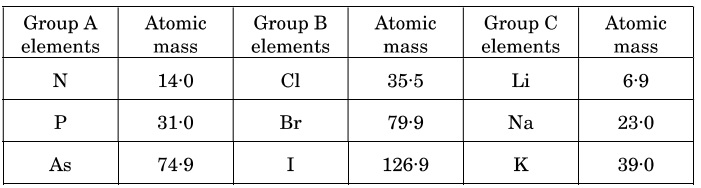
Out of these three A, B and C, the Dobereiner’s triad is/are :
(A) A only
(B) B and C
(C) C only
(D) A and B
17(iii) Which one of the following statements is not a characteristic feature of Newlands’ Law of Octaves ?
(A) Elements were arranged in groups of eight.
(B) Every eighth element had properties similar to that of the first.
(C) Law of Octaves was applicable only up to calcium.
(D) Cobalt and nickel were placed in the same column as fluorine, chlorine and bromine.
17(iv) In Mendeleev’s periodic table, gaps were left for the elements to be discovered later. Which one of the following elements found a place in the periodic table later ?
(A) Germanium
(B) Chlorine
(C) Oxygen
(D) Silicon
17(v) In Mendeleev’s periodic table, the letter ‘R’ is used to represent any of the elements in the group. If R2O and RH are respectively the formulae for the oxides and hydrides of the Group I elements, the formulae of the oxides and hydrides of Group III elements would respectively be :
(A) RO3, RH3
(B) R2O3, RH4
(C) R2O3, RH3
(D) R302, R3H
18. Study the following and answer any four questions from 18(i) to 18(v) :
Visible movements only cannot be the defining characteristic of life. Molecular movements which are invisible to the naked eye are necessary for life. Viruses are said to be living as they also show molecular movements but only when they are inside a living cell. Living organisms are organised structures. They must keep repairing and maintaining their structures. Maintenance of an organism is the collection of processes like nutrition, respiration, etc. In absence of any one of these, life would be difficult. To remain alive, chemical energy is needed by the living organisms to perform vital processes. It provides energy to (a) maintain life processes, (b) produce molecules for repair of worn out cells, and (c) for the growth of the body.
18(i) Viruses show molecular movements when they are :
(A) in crystalline form.
(B) inside a dead material.
(C) in air.
(D) in the body of a living organism.
18(i) The process which involves intake of O5 from outside and breaking down of nutrient molecules to produce energy is called :
(A) Excretion
(B) Nutrition
(C) Respiration
(D) Reproduction
18(iii) Which one of the following statements is incorrect ?
Energy is needed bya living organism to :
(A) maintain life processes.
(B) grow.
(C) repair worn out tissues of the body.
(D) synthesize waste materials.
18(iv) The type of nutrition found in green plants is :
(A) Autotrophic
(B) Heterotrophic
(C) Parasitic
(D) Holozoic
18(v) The function of the circulatory system of human beings is to transport :
(A) Food
(B) Oxygen
(C) Waste material
(d) All of the above
19. Study the following and answer any four questions from 19(i) to 19(v) :
Light seems to travel along straight line paths in a transparent medium. But when light enters obliquely from one transparent medium to another, some changes are observed. This is because different mediums have different optical densities. The extent of the change in the direction of light that takes place when it enters obliquely in a given pair of media is expressed in terms of a ‘constant’. Light travels the fastest in vacuum. Light gets refracted through a transparent prism. Several phenomena are observed due to the reflection, refraction, dispersion and scattering of light by various mediums.
19(i) Rainbow is a natural spectrum. It is produced because of:
(A) dispersion of sunlight by tiny water droplets.
(B) refraction of sunlight by dust particles.
(C) reflection of sunlight by plane shining surfaces.
(D) scattering of sunlight by tiny water droplets.
19(ii) In the given diagram showing refraction of a narrow beam of a monochromatic light through a glass prism, the angles marked ∠1 and ∠2 respectively are :
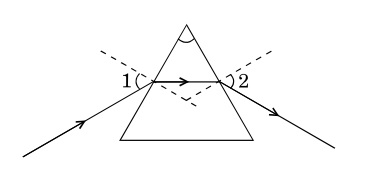
(A) angle of incidence and angle of refraction.
(B) angle of incidence and angle of emergence.
(C) angle of emergence and angle of refraction.
(D) angle of emergence and angle of deviation.
19(iii) Blue colour of clear sky is due to :
(A) Refraction of light
(B) Reflection of light
(C) Absorption of light
(D) Scattering of light
19(iv) The apparent flattening of the Sun’s disc at sunrise and sunset is due to :
(A) Dispersion of light
(B) Scattering of light
(C) Atmospheric refraction of light
(D) Tyndall effect
19(v) Consider the following statements :
- Very fine particles scatter mainly blue light.
- Advance sunrise and delayed sunset are due to atmospheric refraction.
- Violet light bends the least while red light bends the most when a beam of white light passes through a glass prism.
The correct statement(s) is/are :
(A) I only
(B) III only
(C) I and II
(D) II and III
20. Study the following and answer any four questions from 20(i) to 20(v).
Hans Christian Oersted (1777 - 1851) observed that a compass needle suffers a deflection when placed near a metal wire carrying an electric current. This discovery gave the first evidence of a connection between electric and magnetic phenomena. Andre Ampere (1775 - 1836) grasped the significance of Oersted’s discovery. He carried out a large series of experiments to explore the relationship between current electricity and magnetism. On the basis of experiments, he hypothesised that all magnetic phenomena are due to circulated electric currents. Later on many devices such as electromagnets, electric motors, microphones, electric generators, etc. were developed on the basis of magnetic phenomena.
20(i) A magnetic needle is a/an :
(A) isolated north pole pivoted at its centre of mass.
(B) isolated south pole pivoted at its centre of mass.
(C) ordinary needle made of soft iron and pivoted at its centre of mass.
(D) small bar magnet pivoted at its centre of mass.
20(ii) A freely suspended magnet always rests in geographically north and south direction because :
(A) the Earth has two poles.
(B) the Earth behaves as a huge magnet.
(C) the magnetic north pole of the Earth’s magnet is located very close to its south pole.
(D) the magnetic south pole of the Earth’s magnet is located very close to its south pole.
20(iii) When a current flows through a straight conductor, a magnetic field is produced around it. Consider the following statements about this field :
- The direction of the magnetic field of a current carrying straight conductor is determined by right-hand thumb rule.
- A charged body placed in this field experiences a force whose direction is given by Fleming’s left-hand rule.
- The magnetic field lines around a current carrying straight conductor are in the form of concentric circles with the conductor as the centre.
The correct statement(s) is/are :
(A) I only
(B) III only
(C) I and II
(D) I and III
20(iv) The strength of magnetic field of a current carrying solenoid is :
(A) minimum at its ends.
(B) uniform inside it at all points.
(C) maximum at its centre.
(D) zero at its centre.
20(v) Which one of the following particles would not experience a force while moving perpendicular to a uniform magnetic field ?
(A) A neutron
(B) An alpha particle
(C) An electron
(D) A proton
Section B
21. Give the chemical name of the reactants as well as the products of the following chemical equation : 2
HNO3 + Ca(OH)2 → Ca(NO3)2 + H2O
22. (a) Out of the two - hydrochloric acid and acetic acid, which one is considered a strong acid and why ? Write the name/molecular formula of one more strong acid. 2
OR
(b) What are amphoteric oxides ? Give an example. 2
23. Give reason why :
(a) gold and silver are used for making jewellery.
(b) a few metals are used for making cooking utensils. 2
24. (a) "Carbon forms strong bonds with most other elements making the compounds exceptionally stable.” Give reason to justify this statement. 2
OR
(b) Write the electron dot structure of methane (CH,) and ethene (C)H,). 2
25. (a) Label (1) and (2) in the given diagram showing sex determination in human beings.
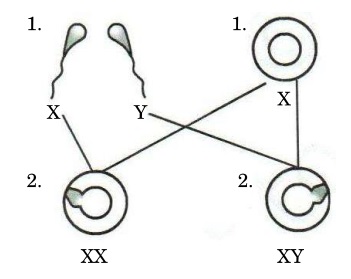
(b) If a child inherits X-chromosome from the father what will be his/her gender ? 1+1
26. What is an ecosystem ? Give one example each of (i) natural, and (ii) man-made ecosystem. 2
Section C
27. What is a displacement reaction ? Write balanced chemical equation for a displacement reaction in which iron is a reactant. Name one more element whose behaviour is similar to that of iron in such reactions. Why will this kind of behaviour not be shown by gold ?
28. What happens when electricity is passed through an aqueous solution of sodium chloride (called brine) ? What is this process called ? Write the chemical equation for the reaction involved. Name the gases evolved at the (i) anode, and (ii) cathode. Name the product formed when these gases combine.
29. The atomic number of an element is 20. Write its electronic configuration. State whether this element is a metal or a non-metal. What is its valency ? Write the name and formula of the compound which this element forms with chlorine.
30. The process of spore formation takes place in many simple multicellular organisms. Name the (i) organism using this process to reproduce, and (ii) reproductive and non-reproductive parts of such organisms. List two benefits to an organism that reproduces through spores.
31. What is placenta ? Describe its role during pregnancy.
32. Two lamps, one rated 100 W at 220 V and the other 60 W at 220 V, are connected in parallel to electric mains supply of 220 V. Draw a circuit diagram to show this arrangement and calculate the current drawn by the two lamps from the mains.
33. What are consumers ? Name the four categories under which the consumers are further classified.
Section D
34. (a) (i) Why do the herbivores need longer small intestine as compared to that of the carnivores ?
(ii) List three types of substances secreted by the gastric glands and state the role of each in the digestion of food in alimentary canal of human beings.
OR
(b) (i) Plants absorb water from the soil. Explain how it is taken up and transported from the soil.
(ii) "When we are injured and start bleeding, it requires the loss of blood from the system to be minimized." What will happen if the blood loss is not stopped ? Is there anything the system would do on its own to prevent the loss ?
35. (a) What is a lens ? List two main categories of lenses. In which category is a double concave lens placed ?
(b) A convex lens of focal length 15 cm forms a real image at a distance of 20 cm from its optical centre. Find the position of the object. Is the image formed by the lens magnified or diminished ?
36. (a) Although electric kettle and electric toaster were used simultaneously in the kitchen to prepare breakfast for the family, yet the two devices could work efficiently due to ‘fuse’ used in the electric circuit.
(i) What is a fuse ? Write the material used in fuse wires. How is a fuse connected in an electric circuit ?
(ii) State the ratings of fuse used in electric circuits.
(iii) What is the function of a fuse ? How does it perform its function ?
(iv) A device uses 1 kW electric power when operated at 220 V. Calculate the rating of the fuse to be used.
OR
(b) (i) Draw a labelled circuit diagram of the circuit used to show the variation of potential difference across the ends of a resistor with current flowing through it. If you use this circuit, what relation would you find between the voltmeter reading, V and the ammeter reading, I ?
(ii) A wire of given material having length 7 and area of cross-section ‘A’ has a resistance of 4 Ω. Find the resistance of another wire of the same material having length l/2 and area of cross-section 2A.